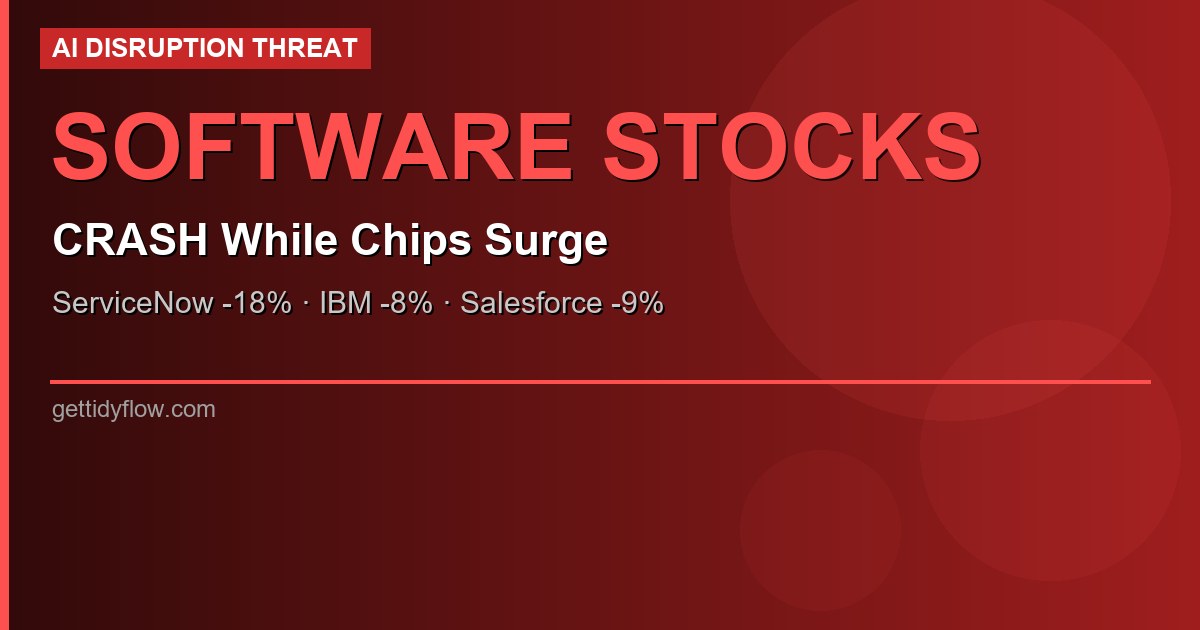
Enterprise software stocks took their worst beating in months on April 24, 2026, after earnings from ServiceNow and IBM — both of which technically beat Wall Street’s estimates — ignited fresh fears that AI-native tools are beginning to cannibalize the cloud subscription model that has driven software valuations for the past decade.
ServiceNow shares fell nearly 18% in their worst single-day drop on record. IBM declined 8%. The selloff spread quickly: Salesforce shed 9%, Adobe fell 7%, HubSpot dropped 8%, while Oracle and Intuit each lost roughly 6%.
What ServiceNow Actually Reported
ServiceNow’s Q1 2026 results were not, technically, a miss. The company reported:
| Metric | Actual | Consensus | Result |
|---|---|---|---|
| Revenue | $3.77B | $3.75B | Beat |
| Adjusted EPS | $0.97 | $0.97 | In-line |
| Subscription Revenue | $3.67B | $3.65B | Beat |
The company exceeded revenue expectations. But management cited the ongoing conflict in the Middle East as creating a “headwind” for subscription revenue, and investors interpreted the cautious tone as a signal that demand generation was softening. The stock’s sequential margin compression compounded the selloff.
IBM’s Mixed Signals
IBM reported Q1 revenue of $15.92 billion, above the $15.63 billion consensus, with adjusted EPS of $1.91 against an $1.81 expectation. Software revenue of $7.05 billion also topped estimates.
Yet IBM maintained its full-year guidance without raising it — a move interpreted by some analysts as a lack of confidence in AI-driven acceleration. The stock fell 8%.
The Real Fear: AI Is Breaking the Subscription Model
The deeper concern driving the selloff is structural, not quarterly. Generative AI tools from Anthropic, OpenAI, and others are increasingly capable of automating workflows that enterprise software companies charge recurring subscription fees to manage.
ServiceNow’s core business — IT service management, workflow automation — sits squarely in the category of processes that AI agents are beginning to handle without human-in-the-loop configuration. IBM’s consulting and enterprise software segments face a similar threat as large language models reduce the labor required for enterprise integration projects.
The market’s logic: if AI commoditizes the functionality that justifies $100–$500 per user per month in SaaS subscriptions, the multiples software companies trade at today — often 15–30x forward revenue — are not sustainable.
The Semiconductor Divergence
The contrast with semiconductor results this week has been stark. Texas Instruments surged 13% on strong data center results, and Intel jumped 25% on AI-driven demand. Hardware companies building AI infrastructure are seen as beneficiaries of AI spending regardless of which software wins.
Software companies, by contrast, are caught in a more difficult position: they must simultaneously build AI features to remain competitive while defending existing recurring revenue from AI-native alternatives.
What to Watch Next Week
The software selloff sets up a critical test for the broader narrative when Alphabet, Meta, Microsoft, and Amazon report on April 29–30. Microsoft’s Azure business and Copilot enterprise AI products will be scrutinized for evidence that AI monetization in software is generating real, incremental revenue — not just protecting market share.
If Microsoft shows strong evidence of AI-driven revenue growth, the software selloff may reverse. If Copilot adoption figures disappoint, the AI-disruption thesis could deepen.
noindex: true
This article is based on publicly available company earnings reports, analyst commentary, and press releases. It is for informational purposes only and does not constitute investment advice.