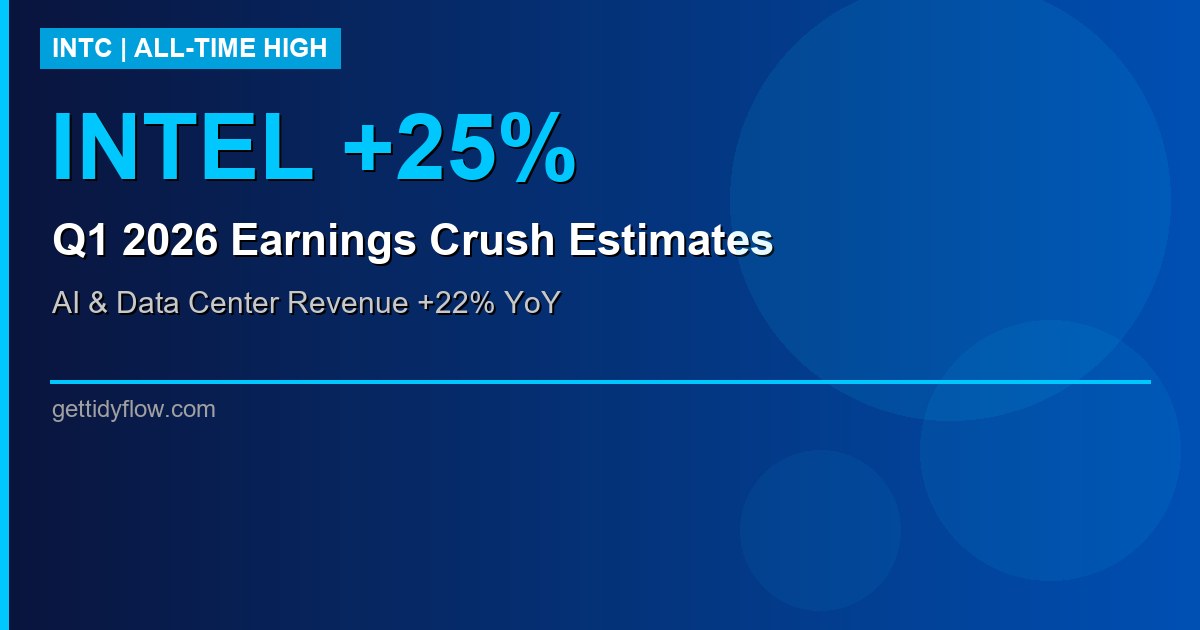
Intel delivered its strongest earnings beat in years, sending shares surging to an all-time high on April 25 after the chipmaker’s first-quarter 2026 results topped Wall Street estimates by a wide margin. The results underscore a dramatic shift in Intel’s business mix, with artificial intelligence and data center workloads now accounting for the majority of its revenue.
Q1 2026 Results at a Glance
| Metric | Q1 2026 Actual | Q1 2026 Estimate | Beat |
|---|---|---|---|
| Revenue | $13.6B | $12.36B | +10.0% |
| Adjusted EPS | $0.29 | $0.01 | +$0.28 |
| Data Center & AI Revenue | $5.1B | — | +22% YoY |
Intel’s revenue grew 7% year-over-year. But the headline figure understates the beat: analysts had expected just $0.01 in adjusted earnings per share, and Intel delivered $0.29 — a result nearly 29 times the consensus estimate.
Data Center and AI Now Drive 60% of Revenue
Intel’s Data Center and AI segment posted revenue of $5.1 billion, up 22% year-over-year and 7% sequentially. AI-driven businesses now collectively represent 60% of Intel’s total revenue, up from roughly 40% two years ago, and grew 40% year-over-year.
The company’s Xeon CPUs — long seen as legacy hardware facing pressure from GPU-centric AI workloads — are finding renewed demand as hyperscalers build out AI inference infrastructure at scale. CPUs handle pre-processing, post-processing, and memory-intensive tasks in AI pipelines that GPUs alone cannot cost-effectively manage.
Intel also announced a multiyear arrangement with Google in which its Xeon CPUs will power AI, inference, and other workloads on Google Cloud. The deal validates Intel’s argument that CPU-based computing remains integral to the AI buildout alongside GPU acceleration.
Q2 2026 Guidance Exceeds Expectations
Intel guided for Q2 2026 revenue of $13.8 billion to $14.8 billion, compared to Wall Street’s prior estimate of approximately $13.2 billion. The midpoint of $14.3 billion represents roughly 5% sequential growth.
The strong guide was a key catalyst for the stock’s after-hours surge. Intel’s stock had already gained more than 80% year-to-date heading into Thursday’s close, and the Q1 beat extended that rally further.
Why the Market Reacted So Strongly
Intel’s outperformance arrives in a week where software stocks were hammered on fears that AI would erode the recurring subscription model. The semiconductor story told a different narrative: companies building the physical infrastructure for AI — chips, servers, networking — are benefiting from the spending surge regardless of which AI software eventually wins.
Intel’s results followed Texas Instruments’ 13% post-earnings surge last week, another chipmaker that outperformed on data center demand. AMD gained 12% on April 25 in sympathy with Intel’s results.
The contrast sharpens a divide in the market: hardware and semiconductor companies are reaping AI infrastructure investment, while enterprise software companies face the risk of AI-native competitors displacing legacy cloud products.
The 18A Wildcard
Intel’s 18A manufacturing process — its most advanced yet — is scheduled for commercial ramp in the second half of 2026. If successful, 18A would make Intel competitive with TSMC and Samsung at the leading edge of chip fabrication for the first time since roughly 2016.
Management did not provide specific 18A revenue guidance on the earnings call, but noted that customer qualification is proceeding and the process remains on track. Intel’s foundry business, which manufactures chips for external customers, is a longer-term driver that analysts are watching closely.
Stock Performance and Context
INTC shares soared roughly 25% in early trading on April 25, reaching all-time highs. The stock had already doubled since early 2025, making it one of the best-performing large-cap semiconductor names in the rally. Intel’s market capitalization pushed above $300 billion for the first time.
The broader semiconductor index (SOXX) gained about 4% on April 25, with Arm Holdings, Marvell Technology, Super Micro Computer, ASML, and TSMC all rising 3.5% or more in the AI hardware updraft.
noindex: true
This article is based on Intel’s official Q1 2026 earnings press release and publicly available analyst data. It is for informational purposes only and does not constitute investment advice.